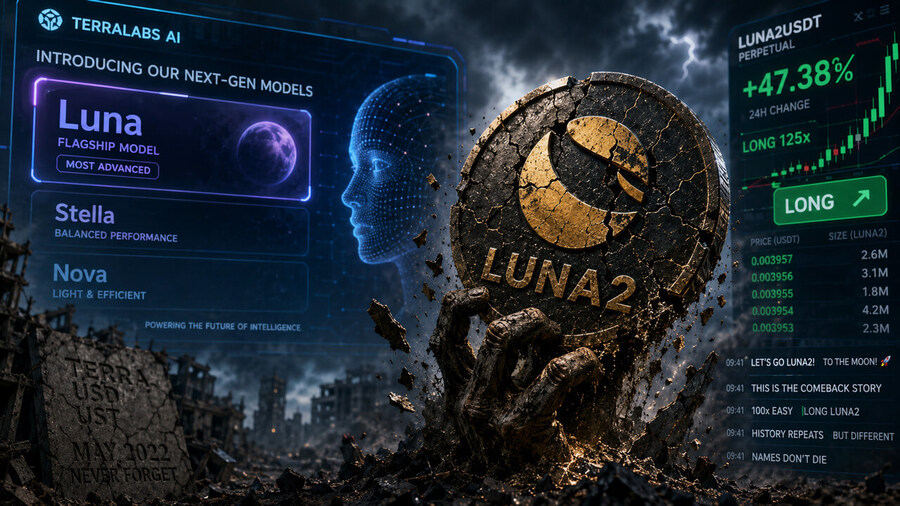
OpenAI’s Luna Branding Sparks Speculative Rally in Terra’s Defunct LUNA Token

OpenAI introduced GPT-5.6 on June 26 with three model tiers: Sol, Terra, and Luna. Sol is the most advanced model, Terra is designed for balanced performance, and Luna is the fastest and most affordable option.
According to OpenAI, Sol delivers performance comparable to Anthropic’s Mythos Preview on ExploitBench while using only about one-third of the output tokens. The company prices the model at $5 per million input tokens and $30 per million output tokens.
For now, GPT-5.6 is available only to a limited group of approved partners through the API and Codex. OpenAI said the restricted rollout follows requests from the U.S. government as the company continues reviewing the model’s capabilities in areas such as biology, coding, and cybersecurity.
However, crypto traders focused on something else: the name “Luna.”
Shortly after OpenAI’s announcement, Terra’s LUNA2 token saw a sharp increase in futures trading on Binance. The token climbed from about $0.0486 to $0.0513 within minutes. Open interest also rose from around 36.5 million to 52.3 million LUNA2, a 43% increase, while funding rates turned positive.
The buying activity was concentrated in crypto derivatives markets, with little involvement from U.S. spot exchanges. Because LUNA2 has a relatively small market capitalization of around $36 million and daily trading volume of roughly $8.5 million, a sudden wave of attention was enough to push its price higher.
The rally was not driven by any changes to Terra itself. Instead, traders reacted to the similarity between OpenAI’s new “Luna” model name and the LUNA2 token.
LUNA2 is the governance token of Terra 2.0, the blockchain that remained after the original Terra ecosystem collapsed in May 2022. The collapse erased about $50 billion in market value, and later the U.S. SEC charged Terraform Labs and its founder, Do Kwon, with fraud related to UST, LUNA, and other crypto assets.
Many traders expected the word “Luna” to attract attention across social media, news headlines, and trading bots. They believed this increased visibility alone could temporarily lift the token’s price, even without any fundamental developments.
The sharp rise in open interest compared with the token’s price suggests that traders were opening leveraged futures positions rather than buying the token for long-term investment.
This strategy is often described as “semantic arbitrage.” Instead of trading based on a project’s fundamentals, traders bet that a well-known word or name will attract enough attention to create short-term price momentum.
Similar events have occurred before. In 2025, the TRUMP token surged after an announcement that top holders would receive invitations to an exclusive gala. PENGUIN also jumped after a viral White House social media post featured President Donald Trump alongside a penguin. Meanwhile, GORK soared after Elon Musk posted the word “Gork” on X, despite having no major development behind the token.
A 2026 academic study on Solana memecoins found that launchpads had already processed more than 40,000 migrated tokens and over 180 million post-migration transactions, showing how quickly new narratives can be turned into tradable assets.
These examples highlight how crypto markets can react to cultural events and popular keywords rather than project fundamentals. A familiar name can be enough to trigger a short-lived wave of buying.
Whether this strategy remains profitable is uncertain.
Supporters believe traders will increasingly monitor AI product launches, celebrity announcements, political speeches, and viral events to identify token names that could benefit from sudden attention.
Skeptics argue the opportunity will become harder to exploit as more traders adopt the strategy. Higher funding costs, stricter exchange rules, and faster competition could reduce profits, leaving only the fastest traders able to benefit.
In the end, the LUNA2 rally shows how quickly crypto markets can respond to public attention. While OpenAI was introducing its latest AI models, crypto traders had already turned the company’s product naming into a short-term leveraged trading opportunity.