
How Much Energy Does Bitcoin Really Use Compared to Data Centers and AI?
In 2025, Bitcoin mining used about 171 terawatt-hours (TWh) of electricity. That sounds large, but it represents around 16% of all energy used by data centers worldwide.
By comparison, all traditional data centers—which include cloud services, social media, streaming platforms, and enterprise systems—used between 448 and 1,050 TWh in 2025. Analysts expect this number to keep rising fast as artificial intelligence (AI) expands.
Data Centers and AI Use Far More Power Than Bitcoin
AI-focused data centers alone are estimated to have consumed between 82 and 536 TWh in 2025. Because AI is growing so quickly, exact numbers are hard to track. Some projections suggest that total data center energy use could exceed 1,000 TWh as early as 2026.
Gartner estimates that:
- AI servers used 21% of data center power in 2025
- This could rise to 44% by 2030
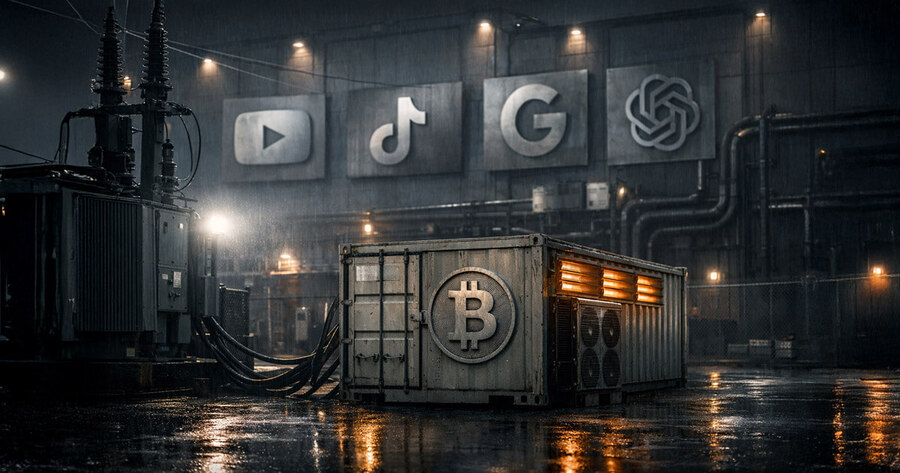
In short, AI, video streaming, and social media already use more energy than Bitcoin—and are growing faster.
Bitcoin Uses a Cleaner Energy Mix
Bitcoin mining relies more on clean energy than most data centers. About 52% of Bitcoin’s energy comes from renewable and nuclear sources, compared with around 42% for traditional data centers.
Bitcoin’s energy mix includes:
- Hydropower: ~23%
- Wind: ~14%
- Solar: ~5%
- Nuclear: ~10%
Coal use has fallen sharply, while natural gas has become the main fossil fuel. Overall, Bitcoin’s energy mix is cleaner than the global average electricity grid.
Why Bitcoin Is Different From Other Digital Services
Bitcoin mining has one major advantage: it can turn off instantly.
This flexibility allows miners to:
- Reduce power use during peak demand
- Help stabilize electricity grids
- Use renewable energy that would otherwise be wasted
In places like Texas, Bitcoin miners are already used as “flexible loads” to help avoid blackouts and reduce the need for expensive backup power plants.
In contrast, AI systems, cloud services, and streaming platforms must run 24/7, which limits their ability to reduce energy use when grids are under stress.
Efficiency Is Improving—but Total Energy Use Keeps Rising
Across Bitcoin, AI, and streaming, efficiency has improved dramatically. New hardware uses far less energy than older systems. However, lower costs lead to more usage, so total electricity consumption still rises.
For example:
- AI systems became much more efficient, yet total AI energy use is expected to grow several times over by 2026.
- Streaming services became more efficient, but total viewing hours continue to increase.
This pattern applies to Bitcoin as well.
Bitcoin vs. the Bigger Picture
Bitcoin uses about 0.6% of global electricity, roughly similar to the annual power consumption of a mid-sized country. Meanwhile, data centers as a whole are on track to consume 3–4% of global electricity within a few years, mainly due to AI growth.
Other cryptocurrencies show that blockchains don’t have to use massive energy. Ethereum, for example, cut its energy use by more than 99% after changing its system. Bitcoin chooses a different design because it prioritizes security through energy use.
So Why Does Bitcoin Get So Much Criticism?
Bitcoin receives far more negative attention per unit of energy used than AI, streaming, or social media—even though those sectors consume much more power and are expanding rapidly.
Bitcoin is not environmentally free. It turns electricity into security, and that choice deserves debate.
But criticism should be proportional to reality.
By the numbers, Bitcoin is not the biggest energy problem in the digital world. The real surge in electricity demand is coming from data centers—especially AI—and that conversation can’t ignore the full picture.