Hashdex Introduces Crypto ETF with a Staking Model Designed to Maximize Potential Returns

Hashdex plans to use a portion of the crypto assets held in its Nasdaq CME Crypto Index ETF (NCIQ) to generate additional returns through staking. Under the proposed structure, Hashdex will receive the first share of staking income, while investors will only begin earning staking rewards after a certain annual threshold is exceeded.
The plan is still being rolled out. In a Form 8-K filed on July 23, Hashdex named Coinbase Cloud as its first staking provider and said staking is expected to begin once operational preparations are complete.
According to a prospectus supplement dated July 23, the staking provider will first deduct its fees from the gross staking rewards. Hashdex will then receive all remaining net staking income until it reaches a threshold equal to 0.25% of the common shares’ net asset value (NAV) each fiscal year through a Sponsor Share, a separate class of shares owned exclusively by Hashdex.
Once net staking income exceeds that threshold, the excess will be split 40% to Hashdex and 60% to the trust, allowing holders of publicly traded NCIQ shares to benefit from the additional staking rewards.
The 0.25% threshold is calculated on an annual basis and prorated for partial fiscal years. If net staking income does not exceed the threshold, common shareholders will not receive any staking income.
For example, if net staking income reaches 1% of NAV over a full year after provider fees, common shareholders would receive an additional 0.45%, while Hashdex would receive 0.55%. These figures are provided for illustration only and should not be viewed as projected or guaranteed returns.
The income Hashdex earns through the Sponsor Share is separate from the ETF’s 0.25% annual management fee, meaning it does not replace or reduce that fee.
Staking fees also vary by asset. According to the NCIQ product page, Ethereum staking carries an 8% fee on gross rewards, Solana validators charge an 8% commission, and Cardano validators charge a 5% commission.
As of July 26, Ethereum (ETH) accounted for 11.75% of NCIQ’s holdings, Solana (SOL) for 3.17%, and Cardano (ADA) for 0.49%, representing a combined 15.41% of the portfolio. However, this does not mean all of those assets will be staked. Hashdex targets staking 10% to 20% of the ETF’s total NAV.
The actual benefit to investors will depend on several factors, including which assets are staked, the percentage allocated, blockchain network reward rates, and provider fees.
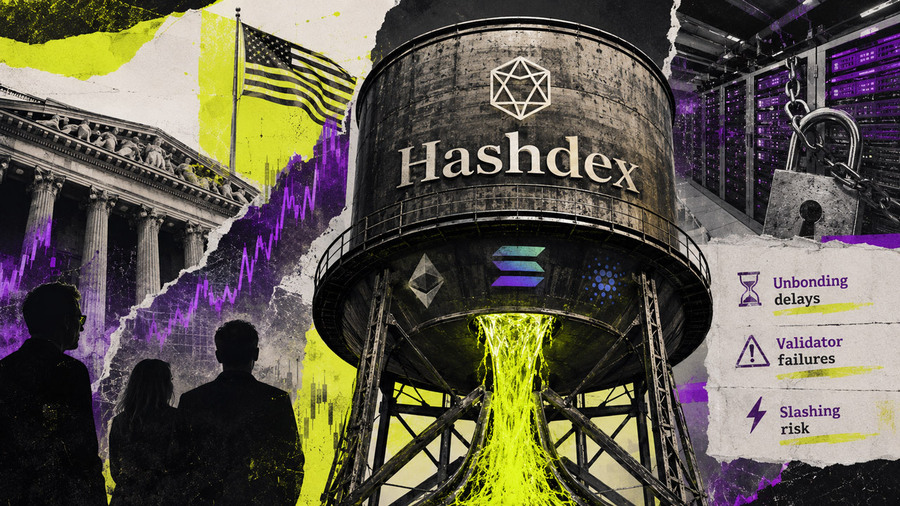
Staking also comes with risks. Assets may be temporarily locked during the unbonding period after staking ends, while validator failures or slashing penalties can reduce staking rewards.
These factors could also affect ETF redemptions and portfolio rebalancing, potentially causing NCIQ’s NAV performance to diverge from its underlying benchmark index. However, Hashdex has not disclosed how significant that tracking difference could be.