New Uniswap Protocol Fee Proposal Could Trigger Significant UNI Token Burn

Uniswap Officially Submits Protocol Fee Proposal, UNI Token Burn Could Increase Significantly
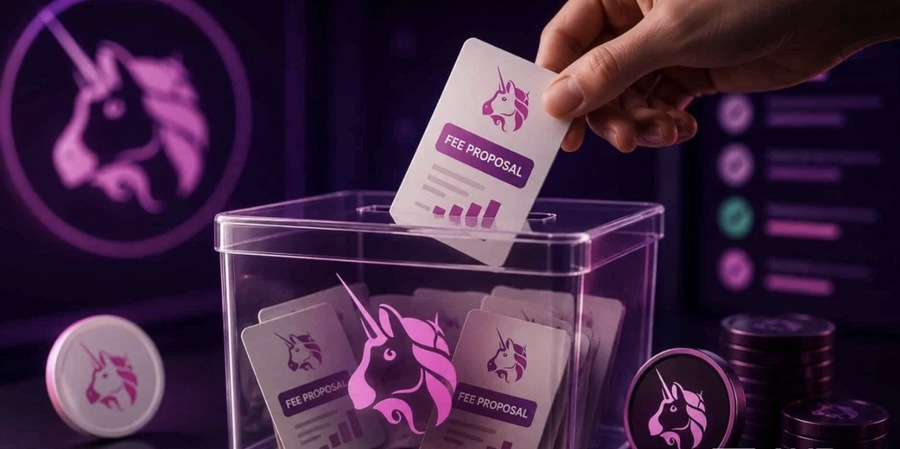
Uniswap has officially submitted three governance proposals to activate protocol fees across multiple blockchains and different versions of its decentralized exchange (DEX).
The first proposal covers protocol fee activation for Uniswap V2 and V3 on the Robinhood network. The Ethereum Layer-2 network launched earlier this month and has already attracted several DEXs, including Uniswap. Within just 10 days of its launch, Uniswap surpassed $1 billion in trading volume on Robinhood, highlighting the network’s growing adoption.
In addition, Uniswap has proposed enabling protocol fees for Uniswap V4 on Ethereum, Base, Arbitrum, Robinhood, BNB Chain, Polygon, and Optimism. Uniswap CEO Hayden Adams said a third proposal covering the remaining V4 networks will also be submitted soon.
According to Adams, all new revenue generated from protocol fees will be directed to the existing UNI token burn mechanism. Based on current trading volumes—particularly on the Robinhood network—he expects the impact on UNI token burns to be substantial.
Proposal Receives Mixed Reactions
For context, swap fees are the fees users pay whenever they exchange assets on Uniswap. Most of these fees are currently distributed to liquidity providers (LPs) as compensation for supplying liquidity to the platform.
A protocol fee, on the other hand, is a portion of the swap fee that becomes protocol revenue after being approved through governance. Part of this revenue is then allocated to the UNI token burn mechanism.
This means that activating protocol fees would reduce the share of fees received by liquidity providers. As a result, several LPs, including Gamma Strategies, have voiced opposition to the proposal for Uniswap V4.
Gamma Strategies argues that Uniswap V4 still trails Uniswap V3 in trading volume. It also faces growing competition from automated market makers (AMMs), propAMMs, RFQ platforms, and order book-based DEXs such as Lighter and Hyperliquid. In its view, introducing protocol fees at this stage could weaken Uniswap V4’s competitiveness.
UNI Burn Could Accelerate
Currently, protocol fees have only been activated on a limited number of Uniswap networks and versions. As a result, most trading fees continue to flow to liquidity providers.
Since 2018, liquidity providers have earned more than $5 billion in cumulative fees, while the protocol itself has generated only about $25 million in total revenue.
If the proposal is approved without hurting Uniswap’s competitive position, higher protocol revenue could significantly increase the UNI token burn rate, as projected by Hayden Adams.
To date, Uniswap has burned approximately 107.49 million UNI tokens. Over the past week alone, the value of UNI burned has more than tripled, rising from around $51,000 to over $160,000.
Can UNI Extend Its Rally?
Momentum from the Robinhood network launch has also supported the price of UNI. Throughout July, the token climbed about 41%, rising from $2.70 to $3.80.
However, bullish momentum has started to fade as UNI remains capped below its 200-day Moving Average (MA), which continues to act as a key resistance level.
If momentum from the Robinhood network begins to cool, UNI could trade sideways above $3.50 or potentially retrace toward the $3.00 level.